How to Slow Down When There’s So Much to Do: A Practical Guide to Capacity-Building
If you’ve ever thought, I can’t possibly slow down right now — there’s too much on my plate, you’re not alone.
Ironically, this is exactly the moment when slowing down matters most.
In coaching, mindfulness, and nervous system science, this skill is called capacity-building — the practice of expanding your ability to navigate life without tipping into overwhelm. It’s how you stay grounded when everything feels like “a lot.”
Capacity-building is not about doing less; it’s about strengthening your internal system so you can handle more without burning out.
Think of it as:
Self-Resourcing (gathering what you need inside yourself)
Inner Refueling (topping up before you hit empty)
Creating Internal Margin (not operating at 100% capacity all the time)
A Nervous System Savings Account (where every pause is a deposit and stress is a withdrawal)
Below are 10 expert-backed reasons why slowing down is essential — even (especially) when life is full — plus simple examples and practices to help you begin.
1. Slowing Down Creates Accuracy
When we rush, our attention narrows. We see less, miss details, and make decisions from urgency instead of clarity. Jon Kabat-Zinn (author of “Wherever You Go, There You Are”) teaches that mindfulness widens perception so we can respond rather than react.
Work example:
You fire off a quick email to "just get it done" and accidentally commit to something you didn’t mean to take on.
Life example:
You buy groceries for a meal you “don’t have time to plan,” then realize you forgot the key ingredient.
Practice: Take a 30-second pause before major decisions. Ask: “What’s actually needed here?”
2. Your Nervous System Needs Downshifts to Stay Resilient
Your nervous system is not designed to stay activated all day. Without small “rests,” the system becomes brittle.
Work example:
You go from Zoom meeting to Zoom meeting with no breaks — by 3 PM you can’t form a clear thought.
Life example:
Your kid spills something and you snap — not because the spill is big, but because your system is overloaded.
Practice:
Try “Inhale 4, Exhale 6” for one minute to signal safety to the vagus nerve.
(Sources: Stephen Porges, Polyvagal Theory; Andrew Huberman, Huberman Lab Podcast.)
3. Busyness Is Often a Coping Mechanism
We often keep moving because slowing down would mean feeling something uncomfortable — exhaustion, grief, uncertainty, or fear.
Work example:
You say yes to a new project because being needed feels easier than acknowledging burnout.
Life example:
You fill evenings with tasks instead of resting, because rest brings up guilt.
Practice:
Ask yourself: “If I slow down right now, what feeling might rise?”
(Inspiration: Tara Brach, Kristin Neff’s self-compassion theory)
4. Slowness Reconnects You to Your Values
Presence helps you distinguish between what matters and what’s just noise. You can’t follow your inner compass while sprinting.
Work example:
You realize the project stressing you out isn’t actually aligned with your goals — you just said yes out of habit.
Life example:
You slow down long enough to recognize you want more time in nature, less time on your phone.
Practice:
Ask: “Does this feel like contraction or expansion?”
Your body will tell you the truth.
(Inspiration from: Martha Beck’s “Body Compass” and Rick Rubin’s “The Creative Act”)
5. Speed Creates the Illusion of Control
Sometimes we hurry because we think if we can just “stay on top of it,” nothing bad will happen.
But urgency is not protection — it’s stress.
Work example:
You obsessively check your inbox because empty inbox = safety.
Life example:
You plan every minute of a family trip so nothing can go wrong… and then you’re exhausted the whole time.
Practice:
Pause and ask: “What am I trying to control right now?”
(Dive deeper by reading: Pema Chödrön’s “When Things Fall Apart”)
6. Slow Is a Power Move
Slowing down isn’t about doing less — it’s about doing things with more presence, intelligence, and impact. In coaching psychology, choosing to pause improves judgment, creativity, and emotional regulation. It’s one of the most reliable ways to reduce cognitive load and increase effectiveness.
Author Elizabeth Gilbert speaks about the power of being relaxed - specifically a Relaxed Woman. 🤯 There are so many reasons why you are more effective when you are in a relaxed state.
For me, it’s the unhurried nature of the relaxed state that speaks to me so potently. It’s a separation of self-worth from achievement. When you feel like you have all the time in the world, you can more easily access feelings of ease, softness, delight, and joy.
Even if you don’t identify as a woman, the principle applies universally: When you’re relaxed and un-rushed, you become harder to knock off center.
People listen more. You make clearer decisions. You access more creativity, presence, and influence. Urgency narrows your perspective; unhurriedness expands it.
This idea is close to my heart — “the unhurried woman” was my mantra for 2025. Not because I want to do less, but because I want to do what matters from a steadier place inside myself.
Work example:
Instead of jumping to answer immediately in a meeting, you take a breath, let yourself think, and then speak from grounded clarity. Your presence shifts the room.
Life example:
Your mornings stop being a frantic scramble. You give yourself five minutes to breathe, stretch, sip your coffee. The rest of the day rises to meet that energy.
Practice:
Choose one daily action to do intentionally unhurried — walking, brushing your teeth, making your bed. Let it be a reminder that pace is a choice, not a condition you’re trapped inside.
““You are allowed to take your time.””
7. Slowing Down Builds Your Capacity for Stress
Somatic Psychology names slowing down as literal capacity-building. When you downshift intentionally, your nervous system learns that intensity is not dangerous — and you become more resilient.
Work example:
You walk into a high-stakes meeting steadier because you paused outside the door.
Life example:
You handle a conflict with your partner calmly because you’ve been practicing presence all day.
Practice:
Try a 2-minute sensory reset:
Notice 3 colors, 3 sounds, 3 sensations.
8. Slowing Down Helps You Prioritize What Actually Matters
We can’t prioritize well when we’re rushed. Slowness reveals what’s essential.
Work example:
You realize 40% of what you planned for the day isn’t necessary.
Life example:
You cancel a non-essential social event and instantly feel more spacious.
Practice:
Ask: “If I could only accomplish one thing today, what would change the game?”
(Source: Greg McKeown, Essentialism)
9. Pausing Prevents Burnout Before It Begins
Burnout rarely comes from one big thing; it’s the slow buildup of micro-stressors with no recovery, per research in positive psychology.
Work example:
You take 90 seconds between tasks to reset — and your afternoons become twice as productive.
Life example:
You stop pushing through exhaustion at night and go to bed 20 minutes earlier.
Practice:
Create a Nervous System Savings Account by adding small deposits throughout the day: breath, breaks, stretching, water, sunlight.
10. Slowing Down Strengthens Emotional Intelligence
EQ (emotional intelligence) depends on awareness and self-regulation — both impossible when you’re rushing.
Work example:
Your team trusts you because you no longer react impulsively.
Life example:
Your children feel more understood because you have the margin to actually listen.
Practice:
At transitions (car → home, meeting → desk, work → dinner), take one grounding breath before speaking.
Capacity-Building Tools You Can Start Today
✔ 1–2 minute breath practices
(Inhale 4, exhale 6)
✔ “One Next Thing” micro-focus
Keep it small.
✔ Creating Internal Margin
Build 5 minutes between meetings.
✔ Inner Refueling breaks
Sunlight. Water. Stillness. A walk around the block.
✔ Self-Resourcing exercises
Place a hand on your chest. Ask: “What do I need right now?”
Try This: A Guided Meditation to Slow Down
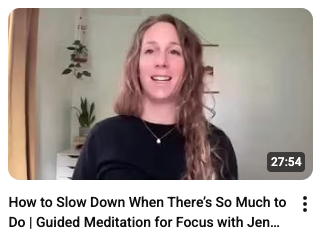
I facilitated a guided meditation class on this topic. And, I recorded it!
Hit play and follow along to put some of this into practice.
It will help you downshift, tune in, and refill your capacity so you can move through the day steadier and more grounded.
▶️ Listen on YouTube:
https://youtu.be/bq9gx1kD5Sc?si=s5ObBps0FBErtJ8t
Join Me: Schedule Your ‘Slow Down’ at The Monthly Reset Ritual
Every month, I facilitate a 1-hour reset.
Together we pause to reflect on what mattered, release what didn’t, and choose one clear intention for the month ahead.
It’s one of the most powerful capacity-building practices I know. All are welcome.
Offered the First Wednesday of Each Month from 1-2pm Pacific. Suggested contribution of $5-15 sliding scale to participate.
Register here: https://calendly.com/jen-otto/monthly-reset